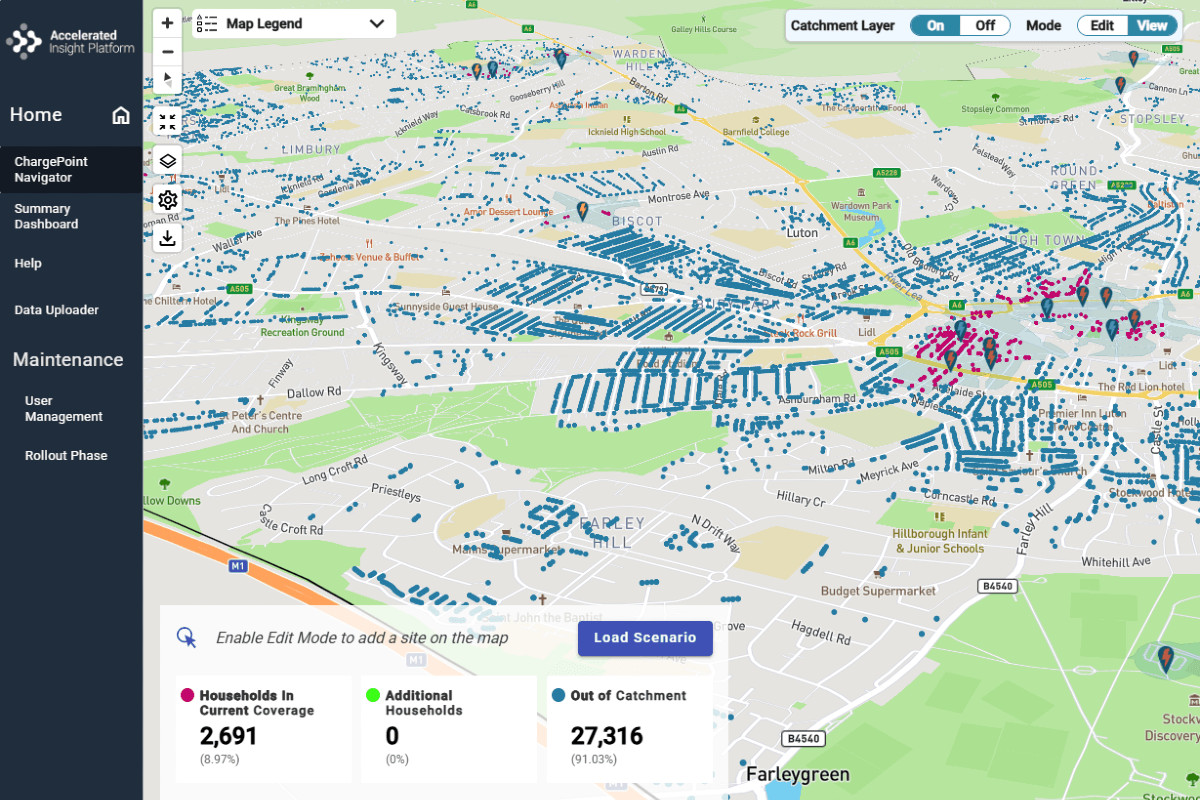
Transport for Wales (TfW) has announced that all 22 local authorities in Wales will receive free access to ChargePoint Navigator, a shared data platform designed to support the planning and rollout of EV charging infrastructure.
The move is intended to give councils a common evidence base when identifying sites for chargers, helping to reduce costs and improve consistency in how charging networks are planned. TfW said the platform would support more transparent and value-for-money investment, while also aligning local delivery with wider national transport policy.
It marks the first time ChargePoint Navigator has been rolled out at a national level outside England. The platform was originally funded and co-developed by UK Power Networks Distribution System Operator and Field Dynamics, and has already been adopted by more than 100 local authorities within UK Power Networks’ operational area.
In late 2025 it was revealed that local authorities using ChargePoint Navigator had secured a 100% first-time success rate in bids to the Government’s Local Electric Vehicle Infrastructure (LEVI) fund. That compares favourably to the 37% success rate among councils that did not use the tool.
While some will argue that maybe the Government needs to make bidding for LEVI funding easier – digital tools are increasingly being leveraged across the electrical industry and by local authorities to speed up the overall process. In fact, UK Power Networks is also speeding up its own processes using a digital tool dubbed 1Streetworks to reduce the length of road closures – with lengthy closures causing a headache for local authorities.
That’s why tools that make the local authorities’ lives easier are so important, and ChargePoint Navigator is coming at no cost to those authorities, with Transport for Wales hoping that its offer will spur a more thoughtful approach to EV charging infrastructure in the country. That’s especially important because it lags behind almost every other region in the UK when it comes to the number of rapid and ultra-rapid charge points, although it fares much better for destination chargers.
It also comes as Wales’ Electric Vehicle Charging Action Plan places greater emphasis on data-led decision-making and better long-term planning. That means rather than simply focusing on increasing charger numbers, it’s eager for local authorities to think about where infrastructure is installed, who it serves, and whether investment is being directed to the areas that need it most.
Tony Clayton, EV Infrastructure Programme Manager at Transport for Wales noted, “As Wales’ EV charging network matures, our focus is shifting from simply increasing charger numbers to ensuring provision is fair, strategic and meets the needs of communities across the country.
“ChargePoint Navigator supports this by bringing consistent data and shared expertise into one place, helping us raise standards and ensuring EV infrastructure contributes fully to our wider transport and decarbonisation ambitions.”
TfW said the initiative builds on its wider support for local authorities, including efforts to improve access to data, strengthen in-house capability, and deliver charging infrastructure in a way that is both sustainable and equitable.
Craig Stephenson, Managing Director of Field Dynamics, commented, “Local Authorities play a critical role in shaping how EV charging infrastructure is delivered on the ground.
“It’s vital they have the right data and tools at their fingertips to make informed decisions and to actively shape outcomes.”
Lynne McDonald, Head of Local Net Zero at UK Power Networks DSO, added, “I’m thrilled and proud to see ChargePoint Navigator going beyond our geographies and now national.
“ChargePoint Navigator was designed with, and for our 133 local authorities to give them the confidence and evidence they need to plan infrastructure that is fair, equitable, and works for their communities.”