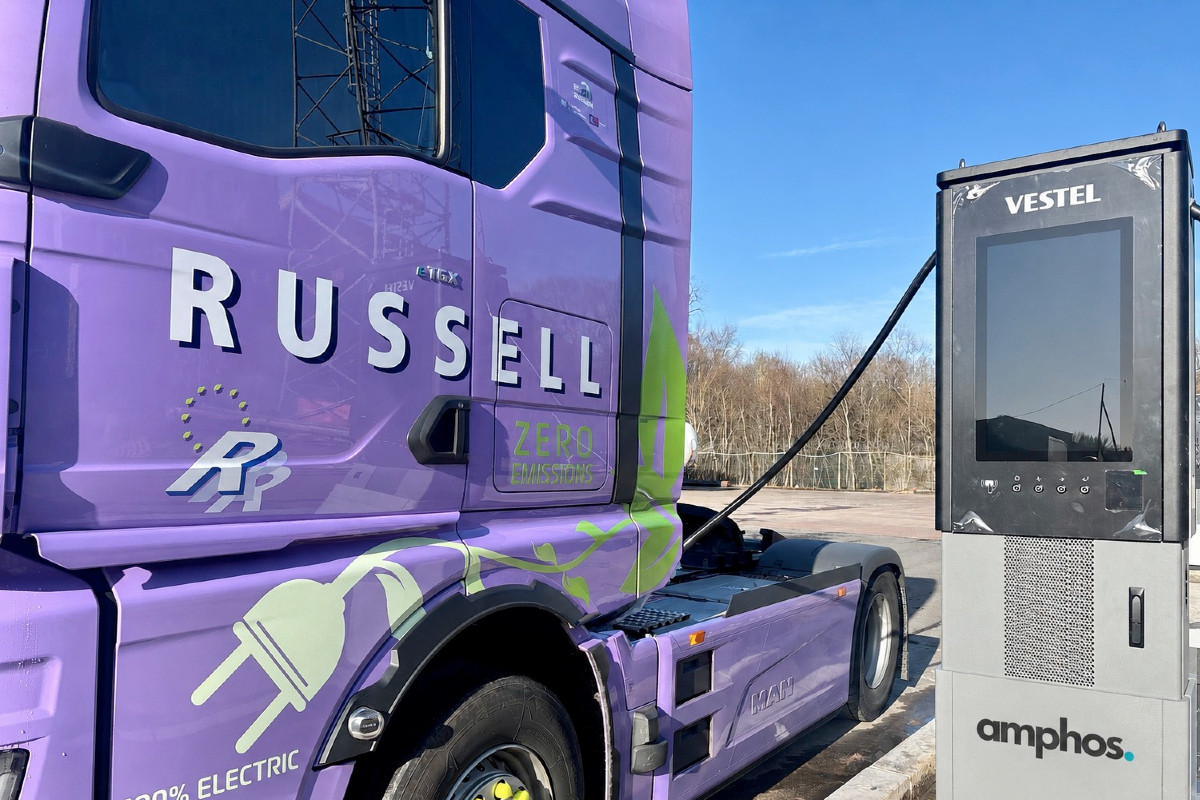
Scotland has finally received its first Megawatt charging hub, with it being located at Russell Group’s Coatbridge depot.
The new charging hub, which was installed by EV fleet solutions company amphos and was partially financed by Innovate UK, comes just months after the UK received its first MCS-compatible charging hub, which Voltempo deployed down in the East Midlands.
As Scotland’s first Megawatt charging hub, it will support Russell Group’s growing electric truck fleet, including three MAN eTGX 4×2 tractors ordered for its subsidiary, John G Russell (Transport).
The vehicles will be used on container services during the day and blue-chip contracts at night, with the company hoping that faster charging will allow electric HGVs to be used more intensively than has traditionally been possible.
Stephen Madden, Head of Engineering at Russell Group, noted, “Megawatt charging allows us to bring a heavy goods vehicle in, charge it during a driver’s break, and send it straight back out fully charged. It’s highly efficient – and that transforms how we operate electric vehicles at scale.”
While Scotland’s first charging hub does support the Megawatt charging system (MCS), Russell Group is currently only able to use the CCS connector as its fleet of HGVs do not currently support the MCS standard. That means its vehicles currently take around 40 minutes to charge, although that is set to change from July 1, with the firm retrofitting MCS connectors onto some of its trucks, which should cut charging times in half.
Each charging unit, manufactured by Vestel Mobility, can deliver up to 3.75 MW of high-voltage DC power. To support the new fleet, Russell Group is installing two 720 kW double-port chargers and one 1.2 MW double-port charger.
Mark Oxtoby, CEO of amphos, noted, “This project marks a pivotal moment for electric freight in the UK. Moving from 1MW to 3.75MW charging isn’t just an upgrade – it’s a step change that brings fully electric, high-utilisation HGV fleets within reach for fleet operators across the country.”
Russell Group says the project forms part of its commitment to reaching net zero across its transport and warehousing operations by 2040.