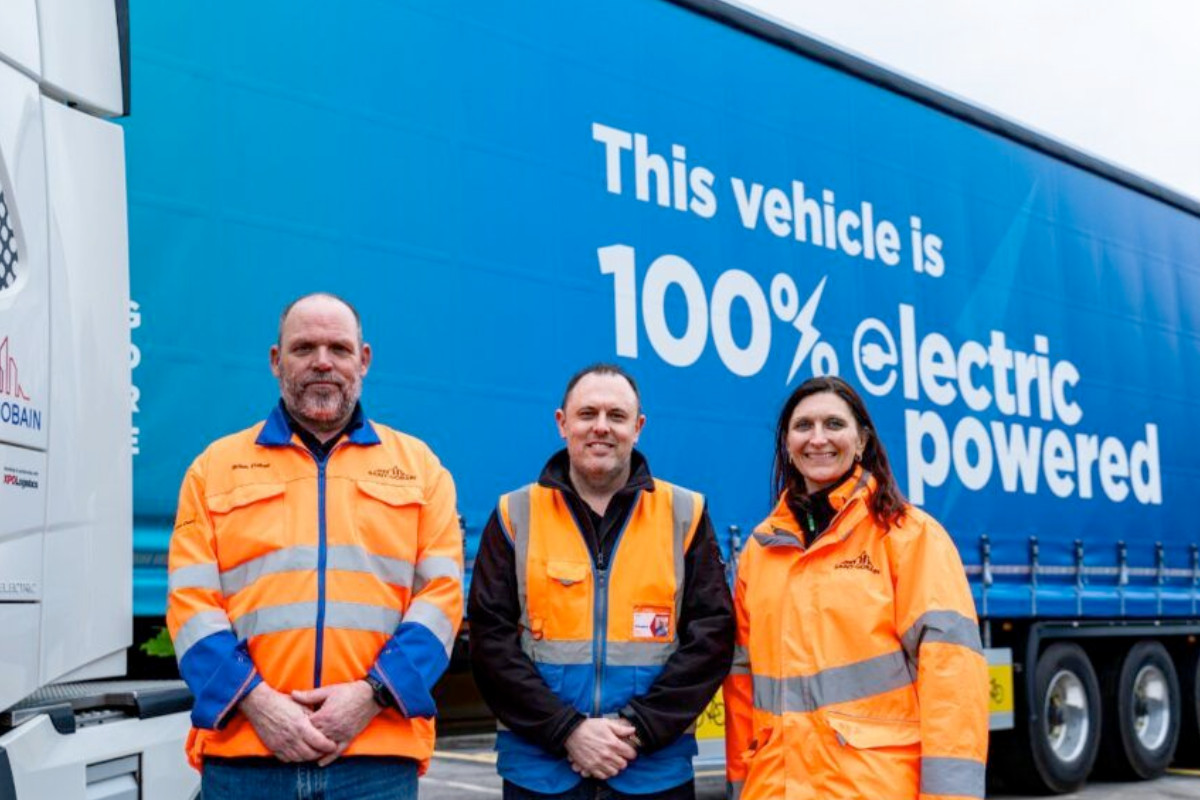
Saint-Gobain has announced plans to install a dedicated electric HGV charging hub in Nottinghamshire as part of a wider rollout of six fully electric trucks in partnership with XPO Logistics.
The charging infrastructure, to be delivered with Gridserve at Saint-Gobain’s Gotham logistics hub, will support a new fleet of five electric tractor units and one rigid truck supplied by Volvo Trucks. The vehicles are due to enter service between April and June 2026, with real-world trials beginning in the second quarter.
While the attention is usually given to the vehicles themselves, the more significant part of this announcement may be the infrastructure behind them. One of the biggest hurdles facing electric HGV deployment is not simply getting trucks onto fleets, but ensuring they can be charged quickly enough to keep logistics operations moving. Saint-Gobain and XPO appear to be addressing that challenge head-on.
The Gotham site will feature four back-to-base supercharging points, rated at 350 kW, with the companies saying vehicles will be able to reach 80% charge in around 90 minutes and a full charge in under two hours. That should give operators a clearer view of whether depot-based charging can support regular delivery cycles without undermining efficiency.
The site will act as a central distribution point for deliveries from British Gypsum East Leake and the Saint-Gobain Midlands distribution centre, with each vehicle expected to complete up to two delivery cycles per day across the Midlands region.
Charging infrastructure takes centre stage
The six electric HGVs form part of the UK Government’s Zero Emission HGV & Infrastructure Demonstrator programme, which launched in October 2023 with £200 million in funding. The programme is designed to accelerate the adoption of zero-emission HGVs across the country, and this latest project underlines the extent to which that ambition depends on charging infrastructure as much as vehicle procurement.
Using XPO Logistics’ emissions intelligence technology, the six vehicles are projected to cut CO2e emissions by nearly 800,000kg a year. Over the five-year ZEHID period, that would amount to 3,530 tonnes of avoided emissions, while supporting more than 12,000 customer deliveries.
Dean O’Sullivan, CEO of Saint-Gobain UK & Ireland, commented, “Trialling six zero-exhaust emission HGVs across the Midlands is another step forward for us. The extended operational trials of the all-electric vehicles are part of our wider journey to reduce the impact of our business and ultimately meet our goal to be a net-zero carbon business.
“We’ll be working closely with customers during this period and our drivers to get their feedback and see how all-electric HGV’s at scale can fit into our logistics service offer. We’re excited to see what’s possible as we push for cleaner, smarter deliveries that support our customers.”
While Saint-Gobain will be trialling its new electrified fleet, the company’s charging infrastructure doesn’t quite compare with some other recent installations. Take Voltempo’s recent project in collaboration with Kuehne+Nagel, for instance. That site features six DC charging bays which are capable of megawatt charging. That charging speed is seen as crucial to making eHGVs viable in the long-term.
That being said, megawatt charging isn’t required for every company. After all, some trucks will have longer dwell times than others, so 350 kW charging could prove to be the right move for Saint-Gobain. It also means it can start the trial sooner rather than later, with megawatt charging still seen as relatively niche and expensive by comparison.