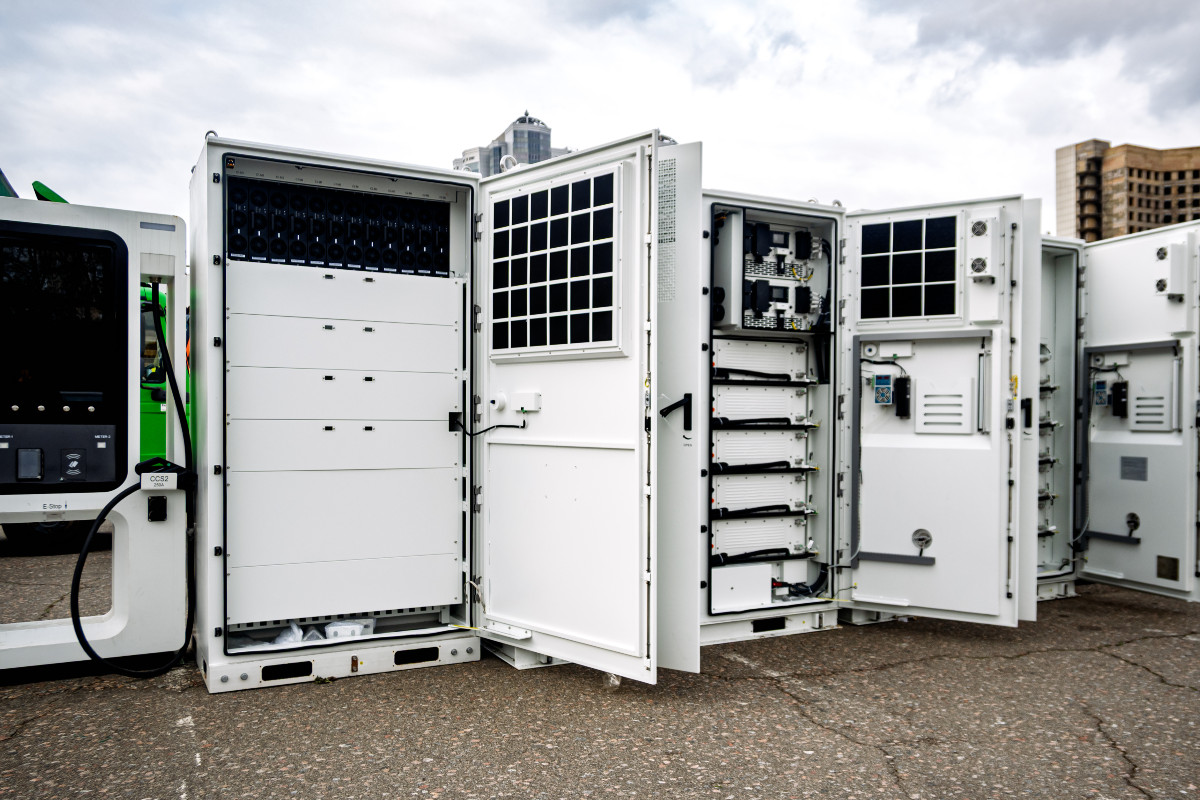
UK Networks Services is seeking suppliers for 22 battery energy storage systems for EV charging hubs across the UK, in what it says is the first phase of a wider programme covering around 160 sites.
The move was announced by managing director Simon Gallagher in a LinkedIn post earlier this week, with expectations that the first systems will be delivered later this year.
According to Gallagher, the first batch will include a mix of 50kW/50kWh, 100kW/100kWh and 150kW/150kWh systems, alongside larger 1,000kW/2,000kWh units. The company will issue full specifications as part of the request for proposal, or RFP.
The timing is notable. As charger power levels keep rising, more of the industry is looking at how batteries can support rapid charging at sites that do not have a large enough grid connection on their own. In simple terms, the battery charges up more steadily from the grid, then releases that stored electricity quickly when a vehicle needs a fast top-up.
That approach is already being talked about more openly. BYD said this month that its FLASH Charging stations in China are paired with battery storage to help ‘break through grid restrictions’. The company said the battery is recharged at slower speeds and can act as both an ‘energy reservoir’ and a ‘power amplifier’ when higher charging power is needed.
The wider market is also moving in that direction. In January, the first megawatt-scale eHGV charging hub in the UK opened at East Midlands Gateway as part of the eFREIGHT 2030 programme, with Voltempo’s system described as the first Megawatt Charging System-ready charger to be deployed in the country. That project is aimed at electric lorries rather than passenger cars, but it shows how quickly higher-power charging is moving from product launches into live sites.
There are still practical questions to answer, however. A site may advertise very high charging power, but that does not mean every vehicle is arriving empty or taking a full charge. Real-world usage is usually messier than that, with some drivers only topping up enough power to finish a journey. That is why battery size, charging patterns and the strength of the grid connection all matter just as much as the headline charger rating. This appears to be the gap UK Networks Services is trying to bridge with its latest tender.
For now, the RFP is only the first step, but it is another sign that battery-backed EV charging is moving closer to the mainstream. For an industry that has spent a lot of time talking about grid constraints, that may be the more important story here.