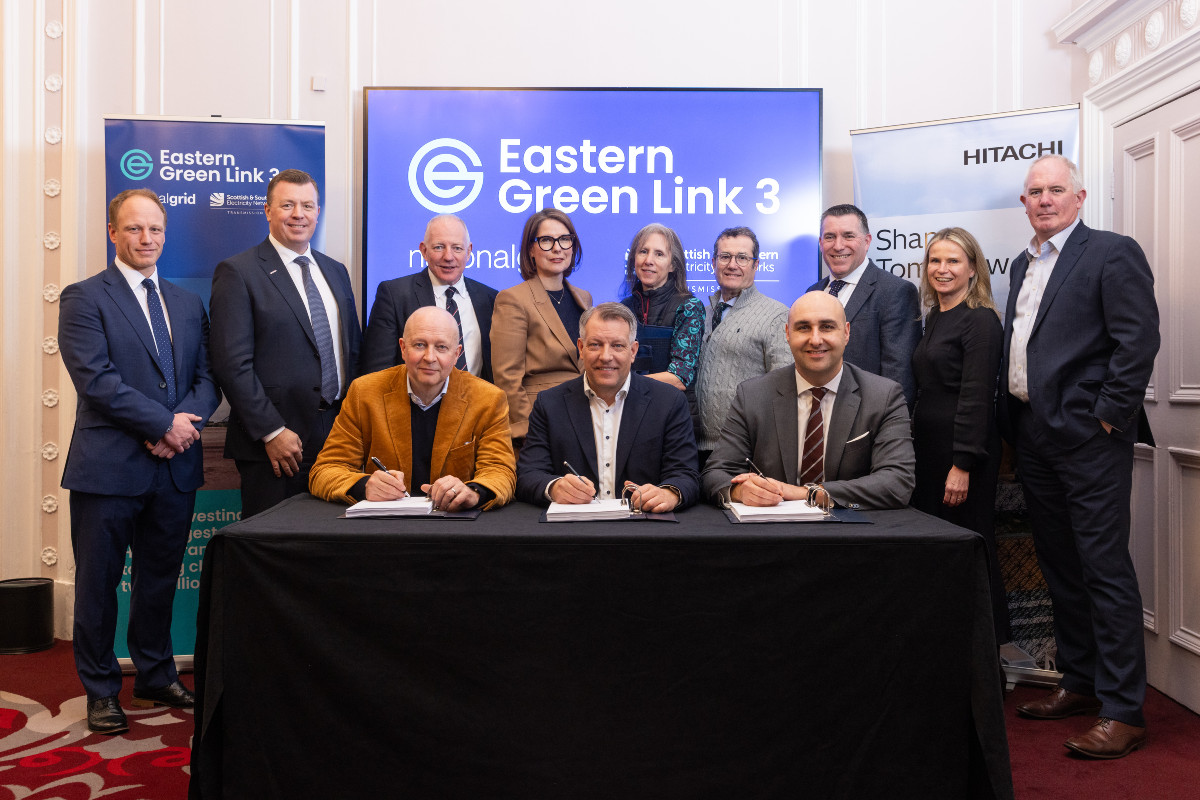
National Grid Electricity Transmission and SSEN Transmission have signed the main delivery contracts for Eastern Green Link 3 (EGL3), the subsea ‘electricity superhighway’ being billed as the UK’s largest ever electricity transmission project of its kind.
The agreements, totalling nearly £3 billion, appoint Hitachi Energy to deliver the high voltage direct current (HVDC) converter stations in Aberdeenshire and West Norfolk, and NKT to deliver the subsea and underground cable system that will link them.
EGL3 is planned as a 690km HVDC link, including around 580km offshore between Scotland and England, with capacity equivalent to powering around two million homes.
The project is being positioned as a response to a growing practical challenge in the UK’s energy transition: renewable generation is increasingly concentrated offshore and along the east coast – particularly in Scotland – while demand is spread across the country. When there is insufficient transmission capacity to move that electricity, wind farms can be paid to turn down generation, creating constraint costs that ultimately feed into bills.
By increasing the amount of power that can be transferred between Scotland and England, the EGL3 joint venture says the new link will help remove bottlenecks, lower constraint payments, strengthen energy security and support a cleaner electricity system.
Mark Brackley, Project Director for Eastern Green Link 3 at National Grid, noted, “Signing these contracts is a major milestone for EGL3 and for the joint venture between National Grid and SSEN Transmission. By working with world-class supply chain partners, we are investing in infrastructure that will reduce constraint costs, strengthen energy security and ensure more clean electricity can flow to homes and businesses across the country, while also supporting jobs and economic growth in the regions.”
James Johnson, EGL3’s Deputy Project Director, added, “EGL3 is a vital investment in the UK’s future energy system. By securing these major contracts, we’re taking a decisive step towards strengthening the electricity network so more clean, homegrown power can flow from where it’s generated to where it’s needed most. This project will play a key role in cutting constraint costs, supporting consumer affordability and delivering long-term economic benefits, while building the resilient infrastructure required to meet the UK’s energy security and clean power ambitions.”
EGL3 has already secured planning in principle for the converter station site in Scotland through the Netherton Hub. In England, the project has completed two rounds of public consultation on the planned works, with a planning application expected to be submitted later this year.
Subject to approval from the Secretary of State for Energy Security and Net Zero, construction is due to begin in 2028. The link is currently expected to be energised in 2033.