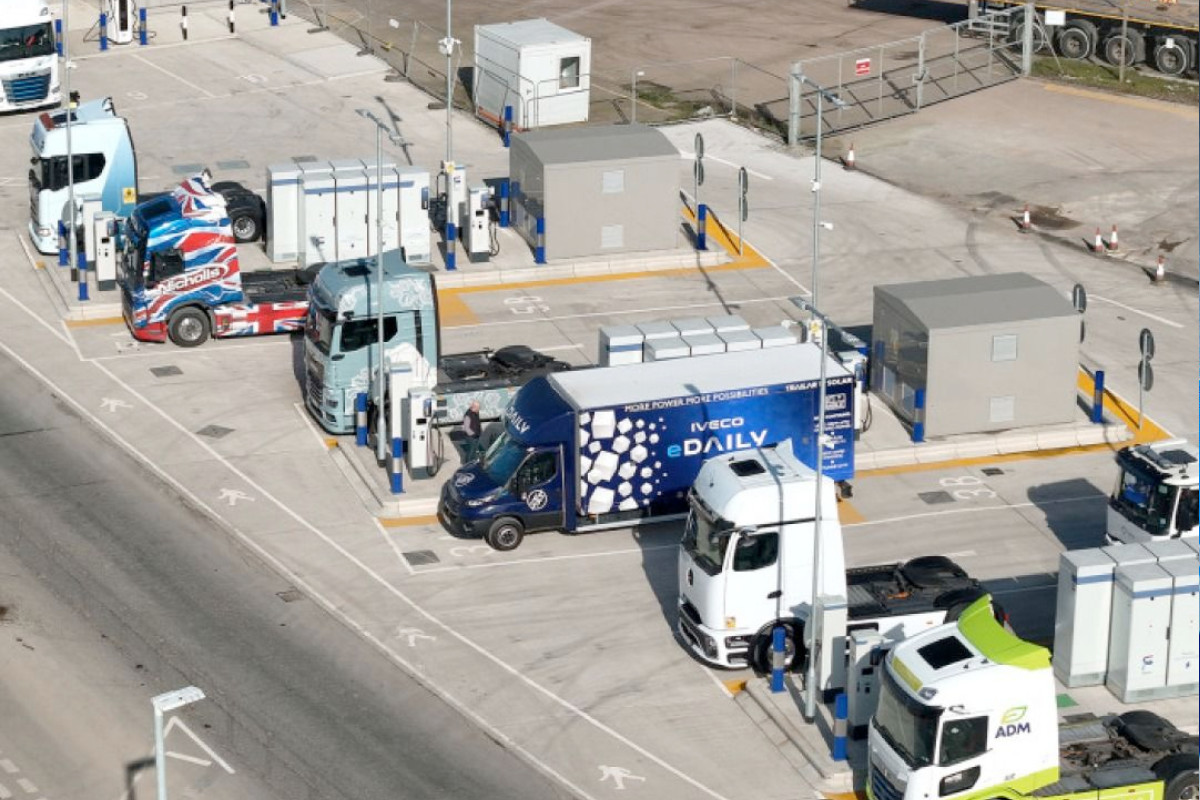
Fleet charging provider Fleete has opened a 5MW commercial EV charging hub at the Port of Tilbury, with 16 ultra-rapid chargers designed to support electric HGV operations along the A13 corridor into London.
Fleete is touting the hub as the largest of its kind in the UK, with the 5MW facility built around 16 ultra-rapid chargers, capable of charging up to 16 electric HGVs simultaneously.
While EV charging buildout is often discussed through the lens of cars and vans, the heavy-duty side is now starting to move from pilot projects to something closer to a pipeline. Industry bodies have pointed to a ‘spate’ of new commercial vehicle charging sites and noted that the Government’s £200m Zero Emission HGV and Infrastructure Demonstrator (ZEHID) programme is intended to enable 54 new infrastructure hubs across accessible locations and the strategic road network.
At the same time, consortium-backed projects such as Electric Freightway are targeting over 200 chargers capable of delivering 350kW and trials of megawatt-ready chargers. We’ve already started to see the first MCS-ready deployments go live too – including Voltempo’s megawatt-scale eHGV charging hub at East Midlands Gateway.
In that context, Fleete’s new charging hub is arriving at a moment when the question is increasingly about scaling infrastructure quickly enough to match fleet ambition, rather than whether electric HGVs can work at all.
A hub built around mixed-supplier charging equipment
Rather than relying on a single charging vendor, the Tilbury site combines equipment from multiple suppliers as part of what Fleete describes as a ‘comprehensive charging offer for commercial vehicles’.
Siemens supplied six Flex 540kW chargers alongside 12 Flex 500A dispensers across three charging islands. Those units are reported to be upgradeable to Megawatt Charging System (MCS) standards, a specification expected to play a central role in faster, higher-power charging for heavy-duty vehicles as the technology matures.
Power Electronics also supplied equipment for the hub, contributing four chargepoints featuring two NB Cooled Dispensers and one NB Station system. These chargepoints deliver up to 270kW per chargepoint, with upgrade capacity to 360kW as part of the eFREIGHT 2030 project.
Government funding helped bring to life shared infrastructure
The development was supported through public funding, including £1 million from the Thames Freeport Seed Capital Programme. Additional backing also came through the Zero Emission HGV and Infrastructure Demonstrator (ZEHID) Programme, funded by the Department for Transport in partnership with Innovate UK.
Chris Morrison, CEO of Fleete, framed the hub as a response to a key industry blocker. “Today marks a major milestone for Fleete and for the wider logistics sector,” Morrison said.
“Our focus has been on proving that shared, high-capacity charging infrastructure can remove one of the biggest barriers to fleet electrification.”
The company also argued that the shared-user approach of its commercial charging hub is particularly important for smaller fleet operators, which often struggle to install depot charging due to upfront costs, limited space, and delays associated with securing higher-capacity grid connections. That is a key differentiator of this site, compared to Voltempo’s installation, which was designed solely for Kuehne+Nagel’s operations.
In that sense, hubs like Tilbury are positioned as a form of common infrastructure – not unlike the public charging networks built for passenger EVs, but designed around the very different requirements of heavy-duty vehicles. If the model works, it could help broaden access to charging beyond the best-capitalised operators.
Fleete says the site has been designed to accommodate additional fleet operators as demand grows, suggesting it expects utilisation to rise as electric HGV deployments scale up.