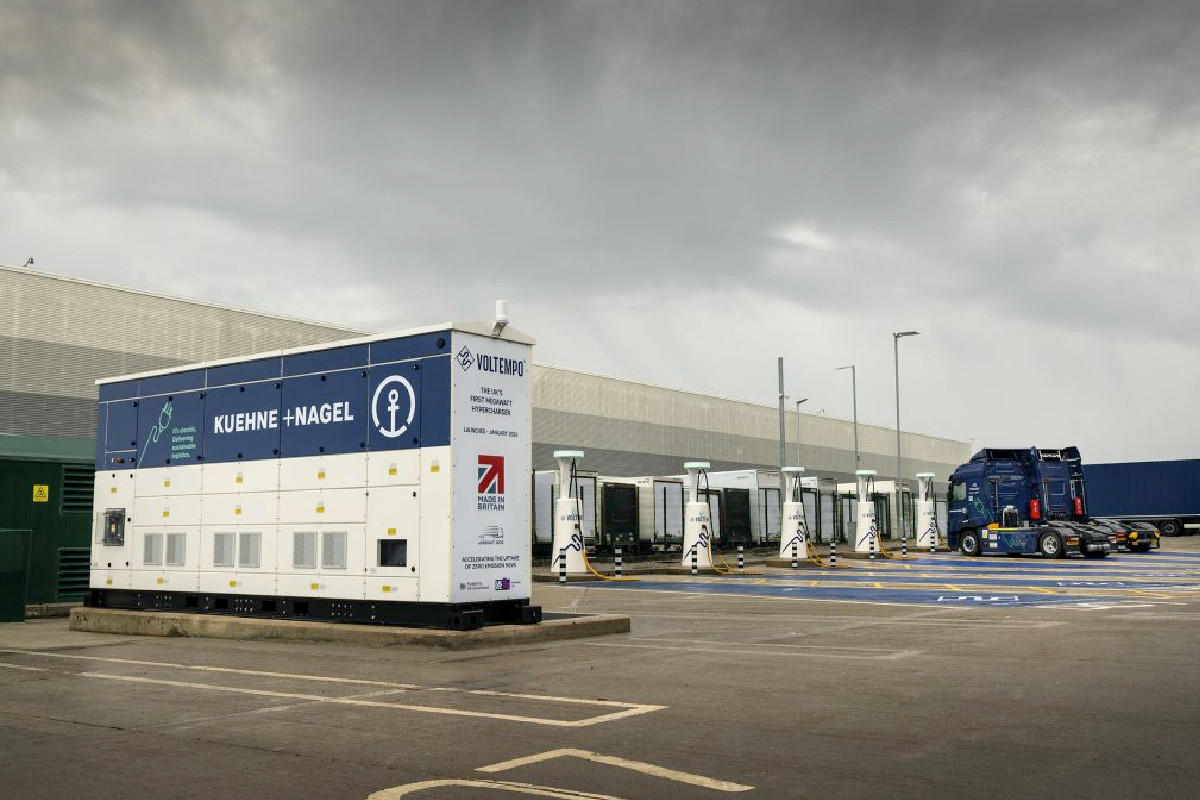
The UK has its first megawatt-scale eHGV charging hub, thanks to a new installation from Voltempo in the East Midlands.
The site, which is located at Kuehne+Nagel’s logistics depot at East Midlands Gateway, has been delivered under the UK Government-funded Zero Emission HGV and Infrastructure Demonstrator (ZEHID) programme, known as eFREIGHT 2030, which is designed to gather operational data and evidence to support the shift away from diesel freight.
At the centre of the installation is Voltempo’s HyperCharger, which the company says is MCS-ready and capable of delivering up to 1MW of power. Voltempo says that level of output can enable an HGV to charge in under 30 minutes, although charge times will vary depending on the vehicle and environmental conditions.
“This first deployment of Voltempo’s HyperCharger at Kuehne+Nagel’s depot is a significant milestone for zero emission freight,” commented Simon Smith, Voltempo’s CEO.
“As lead partner and charging infrastructure provider for eFREIGHT 2030, our focus has been on delivering infrastructure that works for real-world freight operations today, while being ready for the next generation of high-power electric and autonomous HGVs tomorrow.”
While electric cars and vans are now commonplace in the UK’s wider decarbonisation conversation, heavy goods vehicles remain one of the harder sectors to electrify. The reason is simple: charging large batteries quickly, reliably and at scale requires infrastructure that can handle high power delivery, and operational models that fit around depot peaks, turnaround times and route schedules.
That’s what led to the development of the Megawatt Charging System (MCS), but the technology is still in its infancy. Unlike the more commonplace CCS standard, few vehicle manufacturers have adopted MCS, and there are even fewer chargers available. That’s beginning to change, however.
Built around depot realities
Voltempo is pitching the East Midlands Gateway site as a depot-first approach, rather than a public charging model scaled up for bigger vehicles.
The hub includes six DC charging bays, all supplied by a single HyperCharger unit. Voltempo says the system can dynamically distribute available power between bays, enabling multiple vehicles to charge simultaneously while prioritising vehicles based on operational requirements.
That matters because depot charging is typically less about a single ‘fastest possible’ charge event, and more about ensuring fleet availability without disrupting logistics operations. In practice, that means infrastructure needs to be reliable, schedulable, and capable of adapting to changing fleet requirements.
Voltempo also positioned the deployment as the first step in a wider rollout. The company said the East Midlands Gateway installation is the first of 25 planned HyperCharger hubs, and that megawatt-scale charging is expected to feature in up to 35 depot charging hubs planned under eFREIGHT 2030.
Supporting a 12-vehicle trial fleet
Initially, the site will support 12 electric HGVs operating for Kuehne+Nagel on regional, national and international routes. Vehicles named as part of the trial fleet include DAF XF Electric models and Renault Trucks E-Tech T vehicles.
This is where it’s important to note an important detail – the DAF XF does not currently feature an MCS port, while the Renault does. That makes the site useful not just as a charging deployment, but as a live testbed for how fleets with mixed vehicle specifications operate around evolving charging standards.
Beyond keeping the vehicles on the road, the trial is intended to capture real-world performance and cost data. Voltempo and Kuehne+Nagel say they will monitor metrics including energy consumption, charging cycles, range and total cost of operation.
Kate Broome, Sustainability and Social Impact Director at Kuehne+Nagel, noted, “As part of eFREIGHT 2030, we’re proud to be working with partners like Voltempo and their innovative technology, alongside vehicle manufacturers DAF and Renault Trucks, to open the first charging hub at our site – a real milestone made possible through collaboration across industry. Located at the heart of our UK road logistics operations, the combination of the HyperCharger and our new electric fleet enables us to deliver more sustainable logistics for our customers at real operational scale.”
Start of the MCS rollout
The choice of location is significant. East Midlands Gateway sits adjacent to the M1 and close to East Midlands Airport, placing it within one of the UK’s major logistics corridors. In fact, located nearby are depots for Amazon, XPO, DHL, and of course, Kuehne + Nagel. While these chargers won’t be available to the other companies – it’s still a demonstration of how we could begin decarbonising the UK’s fleet of HGVs.
And it’s unlikely to be the last of its kind in the region. Another eHGV hub is already planned further along the M1 at Magna Park, Lutterworth, around 30 miles from East Midlands Gateway. That site is currently tipped to receive 32 MCS-ready chargers delivering up to 400kW per charge point, serving 179 HGV bays with a pull-in bay design suitable for articulated vehicles.