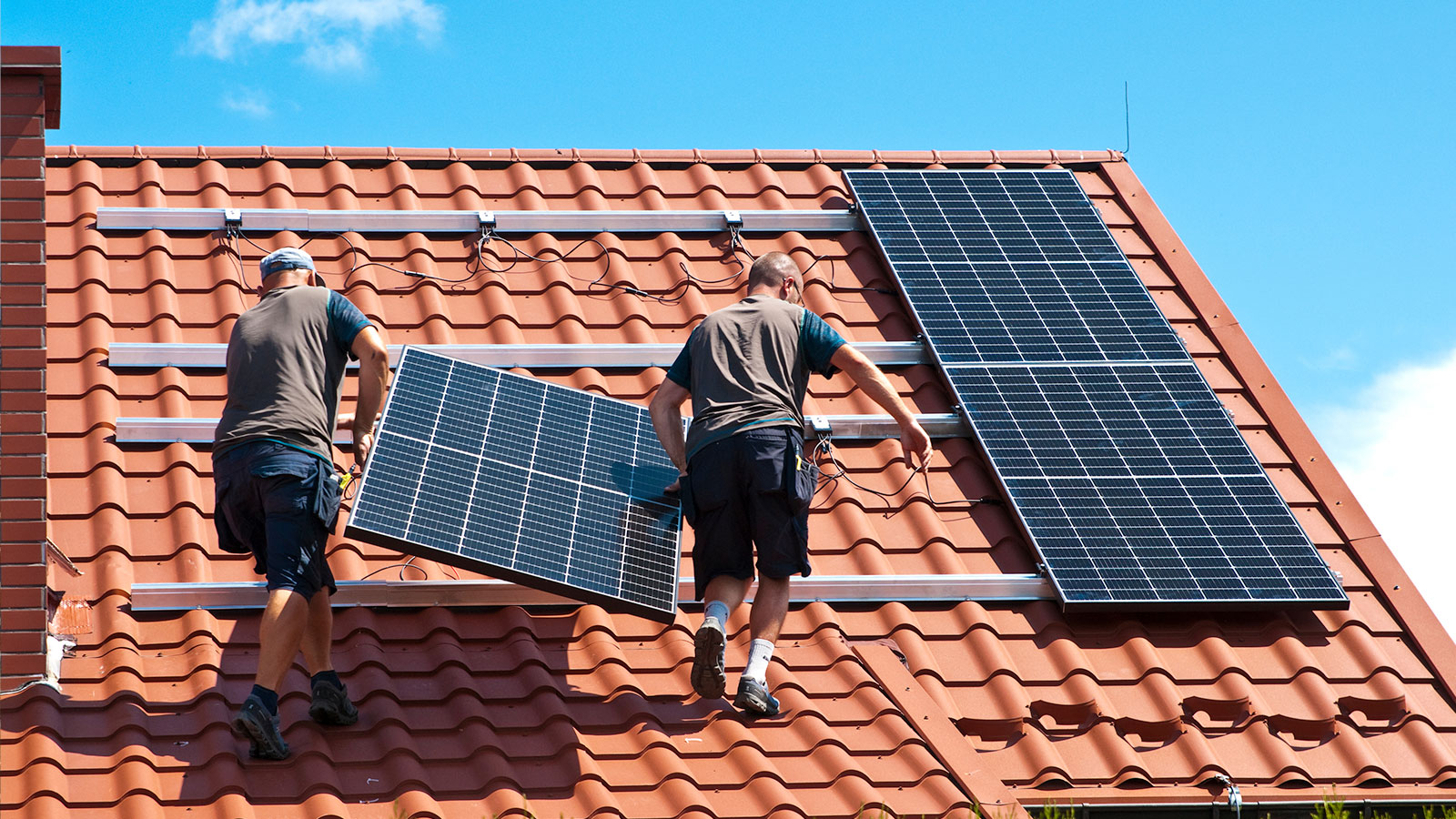
The UK Government has set out a new package of low- and zero-interest loans for rooftop solar and home batteries, with fully funded grants available for some low-income households.
It’s all part of a £15 billion Warm Homes Plan, which the Government is calling ‘the biggest home upgrade plan in British history’. At its heart will be new loans for green upgrades, while also making energy saving upgrades more accessible to those who may not be able to afford the large outlay required.
Under the plan, home owners will be able to apply for Government-backed low- or zero-interest loans to install solar panels, with the same finance also available for home batteries or heat pumps. While it hasn’t confirmed the exact details surrounding the loans as of yet, it has confirmed that it will release further information later this year in conjunction with the UK’s financial sector.
On top of the loans, which will be available to all households, low-income households will get access to new grants. This is targeted at those who could not fully cover the cost of measures such as rooftop solar, with the Government stumping up the cash instead.
Under a similar scheme, dubbed the Warm Homes: Local Grant, local authorities gave those with household income of less than £36,000 access to its grants – which provided up to £30,000, split between £15,000 of home energy efficiency upgrades and £15,000 for a heat pump. It’s not known whether the new scheme will follow the same eligibility criteria, or the same grant cap.
Speaking of the new Warm Homes Plan, Prime Minister Keir Starmer noted, “A warm home shouldn’t be a privilege, it should be a basic guarantee for every family in Britain.
“Today’s plan marks a turning point. It will help to slash energy costs and lift up to a million people out of fuel poverty.
“This is a government bearing down on the cost-of-living crisis. By driving bills down for good and upgrading millions of homes, we’re giving people the security and the fair shot they need to get on in life.”
Energy Secretary Ed Miliband added, “It is a scandal that millions of people in our country do not have the security of a home that is warm, affordable and safe.
“With this investment, we embark on a national project to turn the tide – waging war on fuel poverty and taking another step forward in tackling the affordability crisis for families throughout Britain.”
A target to ‘triple’ solar rooftops by 2030
The Government says the Warm Homes Plan will ‘triple’ the number of homes with solar panels by 2030 – a significant scale-up that would require rapid growth in installer capacity, supply chains and customer confidence.
For the electrical sector, the most immediate questions will be practical ones: whether loan terms are attractive enough to trigger demand at scale, whether the policy avoids the stop-start issues that have plagued previous retrofit schemes, and whether the industry has the skills available to meet any surging demand.
To that end, the Government says it will establish a new Warm Homes Agency, intended to simplify what it describes as a fragmented system and to support consumers from advice through to installation. Consumers will be hoping that it will help avoid the price gouging that has occurred during previous grant schemes – with many noting that prices rose after larger grants were introduced for heat pumps, rather than falling in line with the grant increase.
Industry reaction
Greg Jackson, Founder of Octopus Energy, noted, “The ‘Warm Homes Plan’ is a really important step forward. Electrifying homes is the best way to cut bills for good and escape the yoyo of fossil fuel costs.
“Solar panels can slash energy costs – and paired with a battery we get the electricity when we need it. Heat pumps can be cheaper to run, and with solar they’re often dramatically cheaper. With the right finance, simpler rules and a big push from manufacturers, heat pumps will increasingly be the best solution for many homes – as they are in other countries like Sweden, Norway and Finland.
“We still need to focus on getting electricity costs lower for everyone, building on the changes in the budget, but this plan sends a clear signal that the future of home heating is electric.”
Chris Norbury, Chief Executive of E.ON, added, “We welcome the Government’s action through the ‘Warm Homes Plan’ and its clear focus on practical measures that will help households bring their energy bills down.
“We know from working with our own customers that the most effective way to cut bills is to enable people to generate and store their own energy and combine this with flexible time-of-use tariffs that reward smarter energy use. This approach puts control in customers’ hands, pounds in their pocket and turns the energy system into something that works for people, not the other way around.
“By taking strong action to make sure new energy works for everyone by combining access to innovative solutions with significant funding support, the government is helping unlock real, everyday benefits. It means lower bills, simpler choices and a positive energy transition that people can feel directly in their homes and communities.”
Dhara Vyas, Chief Executive of Energy UK, commented, “Supporting better access to clean heat systems, solar panels, batteries and other low-carbon technologies will help millions of households across the UK bring down their energy bills.
“£15 billion is a substantial commitment, and it’s great to see the plan has an offer for all households with substantial grants for clean heat solutions and affordable finance options for various low-carbon technologies, as well as fully funded measures for fuel poor and low-income homes.
“The Warm Homes Plan also provides certainty to investors and businesses in the energy market, and will drive growth, supporting the creation of thousands of good jobs across the country.”
Gemma Grimes, Director of Policy and Delivery at Solar Energy UK, concluded, “Installing solar panels can slash hundreds of pounds off household energy bills each year, especially when combined with a battery energy storage system and a heat pump. With the loans and grants provided through the ‘Warm Homes Plan’, a huge proportion of the UK population will share the benefits. Almost two million smaller-scale installations have been made already, on homes and businesses – the industry stands ready and able to build millions more by 2030.”